Why do the lights flicker?
One flickering bulb is usually the bulb, the socket or a dimmer that doesn’t get along with LEDs. Lights flickering in several rooms, or dimming hard whenever the AC or the dryer starts, points somewhere upstream: a loose neutral, a failing connection in the panel, or trouble on the service coming into the house.
Where that trouble sits decides who fixes it. Metro Codes makes the owner responsible from the point where NES’s drop connects to the riser and meter base, and damage on the owner’s side is repaired by a licensed electrical contractor. If half the house is dark and the other half is bright, call NES at 615-736-6900 first, then call us.
Why does a breaker keep tripping?
A breaker trips for one of three reasons: too much load on the circuit, a short, or a ground fault. Now and then there’s a fourth, a worn breaker that trips below its rating. Each has a different fix, which is why resetting it again and hoping isn’t a plan. NES’s guidelines need no Electrical Release to replace a breaker, so once we know it’s the breaker, that part goes quickly.
Blown fuses follow the same logic, with one extra hazard: a fuse box is easy to overfuse. If someone has put a 30 where a 15 belongs, the wire has become the fuse.
The odd ones
An outlet that works in the morning and not at night. A switch that controls nothing anyone can identify. A porch light that comes on by itself when the neighbor runs his leaf blower. Jamie has a soft spot for this kind of problem, the odd unexplained one, and has been known to go looking for them. Bring him yours.
Do you need surge protection or a safety inspection?
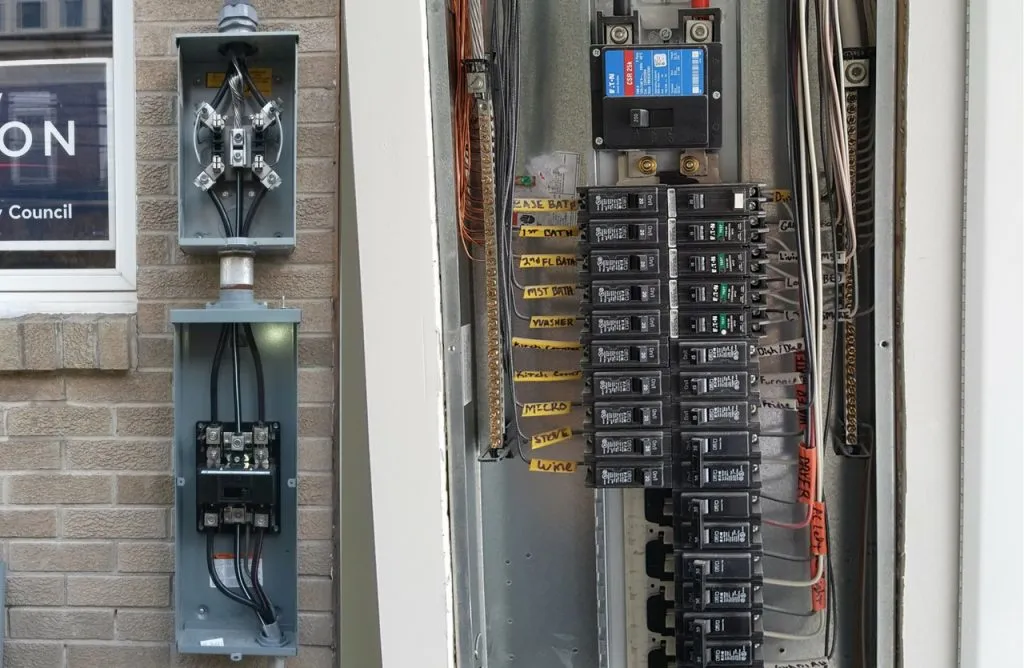
A whole-home surge protective device mounts at the panel and takes a spike before it reaches the electronics: the HVAC control board, the appliances with circuit boards in them, the garage door opener. The photo above shows one on a meter base and panel from our gallery. Plug-in strips still help at the TV and the computer; the panel unit handles what arrives on the service.
A safety inspection looks at the service and the panel, a sample of outlets and switches, the GFCI and AFCI protection, and the smoke and CO alarms, so you know what’s urgent and what can wait. It makes sense after buying an older house or before a remodel.
What moves the price of a repair is mostly the hunt: how hard the fault is to find, how much wall or attic has to be opened to reach it, and the part at the end, each a line on the itemized estimate.