
What is the difference between GFCI and AFCI protection?
A GFCI watches for current leaking to ground, the kind that runs through a person standing on a wet floor, and cuts the power in a fraction of a second. That’s why they belong by sinks, outdoors, in garages and in basements. An AFCI listens for arcing: a damaged cord, a nail through a cable, a loose connection heating up behind a wall. One protects people from shock; the other protects the house from fire.
Metro Nashville inspects new work to the 2023 NEC, which asks for more of both than the codes most older houses here were built under. Either kind can go in as a receptacle or as a breaker in the panel, and the right choice depends on the circuit.
Is aluminum wiring dangerous?
It can be, and the CPSC has the numbers. Its Publication 516 says homes built before 1972 and wired with aluminum are “55 times more likely” than copper-wired homes to have a connection reach fire-hazard conditions. The trouble lives at the connections, where aluminum expands, oxidizes and loosens over the years.
If your house went up in the late 1960s or early 1970s, look at the cable jacket in the attic or basement for “AL” or “ALUMINUM”. If it’s there, have the connections looked at before you add outlets to those circuits.
Dedicated circuits, new outlets and switches
Some loads want a circuit to themselves: a microwave, a dishwasher, a disposal, a garage freezer, a window unit, a workshop. Sharing one is why the breaker trips when the microwave and the toaster run together. New outlets go where the furniture actually ended up, and new switches go where you walk in.
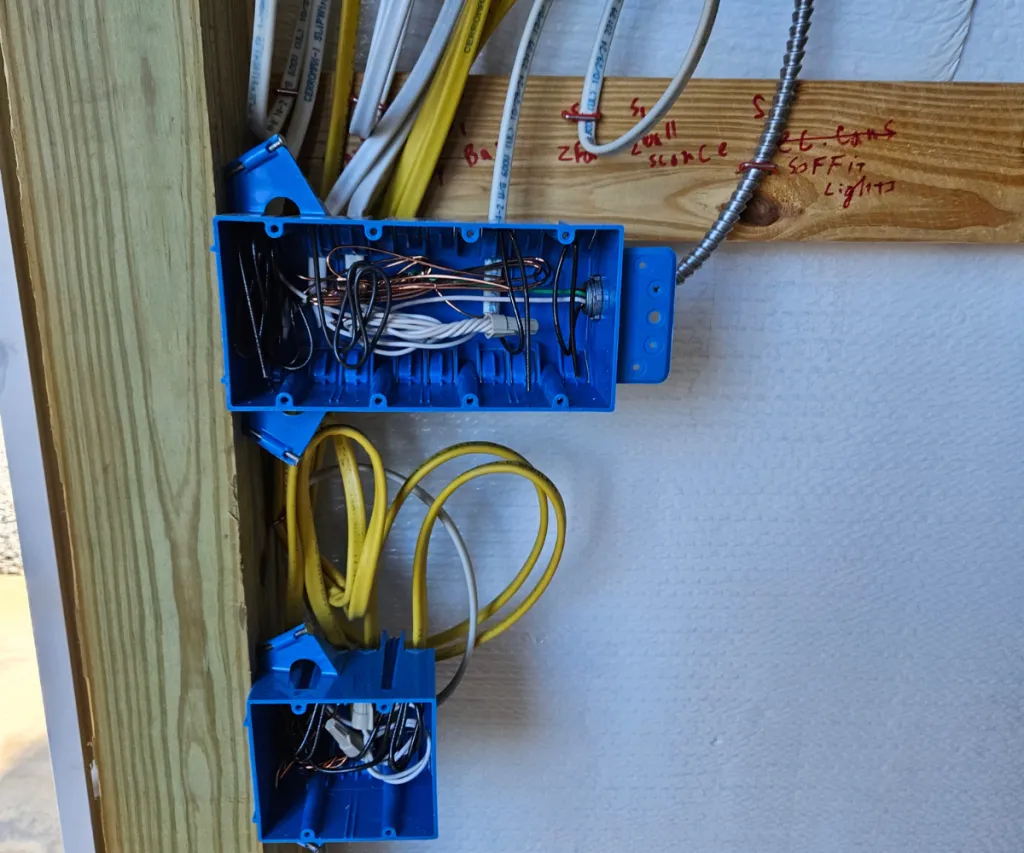
The blue boxes in the photo are the stage nobody sees afterward, the rough-in before drywall. Jim M.’s review on this page is about the finished version of that work, new outlets and switches, and he called the result neat and on time.
When is a whole-home rewire the right call?
When the wiring is ungrounded throughout, aluminum on most circuits, cloth-insulated and brittle, or so patched over the decades that tracing one circuit takes an afternoon. A rewire is mostly a drywall job with electrical in the middle: cable gets fished through walls and ceilings, then the openings get patched and painted. We do both halves.
Smoke and CO alarms usually come along on a rewire, hardwired and interconnected so one alarm sets off the rest.
The cost turns on the size of the house, plaster or drywall, attic and crawlspace access, whether you’re living there during the work, and how much patching follows. The estimate breaks it out item by item.
“Excellent service! The electrical outlets and switches were installed professionally, neatly, and right on time.”